Tuesday, March 19, 2024

Heart Attacks and Heartbreaks

     As the gods have foretold since the beginning of time (start of the project), there had to be something to absolutely ruin my schedule. Case and point, the obstructive piece got rained on. And me and my mother's hard work - sweat and tears and blood!!!! And also mosquito bites!!! Damn the mosquitoes!!- gone. The darker portions that we recently worked on (unfortunately, I did not take a picture of our progress before it was demolished to mere atoms - neither did I of the ruined aftermath since it also demolished my mental state to mere atoms) became smudged and wore off, and also bled into the middle white square. So this pushes back the schedule much more than I would've liked and am comfortable with. This final week before spring break was going to be dedicated to finish editing and filming, especially within the limited time of 6 daylight hours total, will now be spent repainting what's needed and then filming. In reality, filming and editing could be accomplished at any time and would be relatively easy to complete. However, Beacon does not allow checking out equipment during that time so filming is still limited to the 19th and 20th. The 19th is now dedicated to filming the remaining scenes not needing the obstructive piece and repainting, and the 20th is dedicated to filming scenes with the obstructive piece. Unfortunate, but doable. Probably. 

    Fortunately, the utilities available is in our favor. For example, Nyx is back so painting will be much quicker, in which I may enlist another friend because time, and we have spray paint bottles, specifically white and black. For the smudged interior of the piece, we will use the white to do a thick coating to even out the paint and cover up the mixed colors. As a result of my absolutely obliterated mental state, I weighed my options of how to continue with the project: 

1. Repaint.

2. Spray paint a different version (for time's sake).

3. Change the story.

    Issues with 1: T.I.M.E...and stress

    Issues with 2: Disrupts our previously determined meanings of our painting and its relevance to the character's issues and opening's themes. Probably wouldn't look as good too. Hurts my well-being as well because of my extreme meticulousness which is frankly my strong point for wanting to cover all details and create a product that I am confident in through production and content, and also a pain in my butt since I can't just let things be without reason nor can I wing and call an evidently insufficient product to be its final. Due to time, it unfortunately seems like I will not be able to redo the sequence of building anxiety (as previously discussed).

    Issues with 3: We can no longer do the brilliant title transition, and also: T.I.M.E. Also hurts my meticulousness. 

    And so, evidently, we are doing option 1. Good luck to us!...right? 

Friday, March 15, 2024

Prop Issues

         There were some issues with the obstructive piece, mainly because of its size. It being 6x9 ft, takes an extremely large amount of paint, and so it put a hole in my wallet. To mitigate that, I used previous cans of wall paint and mixed it with darker colors I have available, so that for example, I could have an abundance of pink, red, or blue. However, the drawback to this was that I would be mixing colors with a thick white, leading to them all being lighter toned. As discussed previously, I wanted the piece to be mainly darker colors. Additionally, in the manner of how we were painting (dashes and blotches here and there semi-evenly spread out across the perimeter), there were a open spaces to cover, despite two coats. All these factors made me question the entire process itself, especially as I continued on top of the base using darker blacks, blues, reds (the only colors available to me at the time). However, upon lifting it up, I realized (with a lot of my mom's support, bless her) that the only thing left was to trust the process and continue what I was doing because it was on the right track, there only needed to be much more of it.


Wednesday, March 13, 2024

Conventional/Unconventional Genre Application - Relevance to Target Audience

    
    Coming of age films generally revolve around one certain even signifying the transition into maturity. Its introduction and history lies heavily in the 1950s and 60s as Rebel Without A Cause became largely popular, amidst other popular works and movements like Catcher in the Rye and Beatniks, each promoting and introducing the unconventional and thought-provoking lives of teenagers. For example, Catcher in the Rye directly targeting themes of the self/societal alienation and the character's criticization of superficiality and conformity. Beatniks were teenagers and young adults who also rejected the extremely popular social conformity and mainstream consumerism - the 60's immersion into, and popular expression of, the "American Dream" - reflected in artistic expression like literature and painting during the mid-20th century. Furthermore, Dead Poet's Society is another coming of age film reflecting breaking expectations set by parental figures, or otherwise, figures in authority. Our film opening more closely reflects coming of age films, literature, and social movements of this kind rather than the more popular versions that revolve around romances and school settings, with their maturity event being love, embarrassment, adventure, or trials of reality... although this one is a trial of reality.


    Before discussing traditional coming of age films, The Outsiders revolves around a group of young adults/teenagers in the 60's, explores the significance and impact of brotherhood and close relations on conventional standards of the young American man, as the group becomes entangled in gang wars and murder. For context, I haven't watched the movie. The reason for this book's relevance to the opening is mainly its extreme emphasis of the emotional impact of dramatic, life-changing events on characters rather than flippant, people-pleasing moments. I had to talk about it, it's a favorite. Anyways.


    Didn't know Ralph Macchio was in it. The man blessed with envious genetics.

    Traditional coming of age films tend to films like The Breakfast Club, Wargames, Ferris Bueller's Day Off, and Love, Simon. Each of these films challenge relationships, love, and trials of the reality, albeit some... extravagant... ways like possible nuclear warfare and the evolution of supercomputers and artificial intelligence. If you like such AI warfare, I'd recommend Crucible by James Rollins. Furthermore, popular coming of age films that convey tendencies to the traditional and conventional aspects of the genre are Mean Girls, Superbad, and Lady Bird. These films are representative of the long-term traditions of similar themes across decades. 


    Coming of age films target teenagers and young adults, ages ranging from 13-19, and with no specifically targeted gender - the no gender specification is because of modern day's exploration of diverse representation in media and films. Additionally, modern films of the genre convey more complex themes within a simple topic, such as racism, transphobia, mental health, poverty, etc. This target audience is because of the tropes of the genre targeting first love, friendships, school, family, etc. 

    As our mise-en-scene elements depict, there is a desk messy and full of random items and painting materials, the characterization portrays emphasis on the freedom of expression in thoughts and emotions, and the obstructive piece/medication is representative a degrading mental health - each of these topics are relevant to the changing (or otherwise, modern) mentalities and situations that teenagers currently experience/hope to experience. Although I pray they hope for freedom rather than a degradation or regression. And pray for becoming a more organized person, as I do. 

    Our film opening also deviates from conventional standards as the character isn't surrounded with numerous characters, embodying a conflict closer to Man v. Self (further emphasized by a minimal cast), evident in the ending continuation as the only explicit relationships the main character has is with her dog and her psychiatrist.


https://www.masterclass.com/articles/coming-of-age-movies

https://princetonbuffer.princeton.edu/2014/06/12/the-coming-of-age-of-coming-of-age-films/#:~:text=Traditionally%2C%20the%20coming%2Dof%2D,%2C%20Weird%20Science%2C%20Heathers)%2C

https://thesixthformreview.wordpress.com/coming-of-age-films/#:~:text=According%20to%20Medium.com%2C%20coming,growing%20pains%20of%20entering%20adulthood%E2%80%9D.

Anundson, A. (2015). Carpe Diem and Coming-of-Age in Dead Poet's Society. Film Matters, 6(3), 92-94. https://doi.org/10.1386/fm.6.3.92_1


Intelligently Studious Activities

    Intelligently studious activities conducted during filming are as follows:


     Dawg on da counta⁉️⁉️⁉️⁉️


Intelligently studious activities will return….


Monday, March 11, 2024

Production - Versatility vs. Restrictions

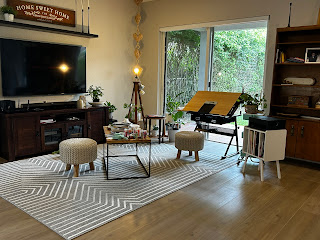
    Our first filming day is complete, with lots of struggle and achievement. Creating the set was fun, and we worked around the absence of an easel since my sister had a large desk, which the surface was able to move just like one, so it was perfect for the set, and we cleared most large furniture for the set we desired. However, since our desired space was set up against a large window in a corner of the living room, there wasn't much space to maneuver in, which constricted the variety of shots, angles, and compositions we could use. Despite this, we were able to film generally smoothly, with only little frustrations due to doubt - doubt that will most likely clear up in post-production.

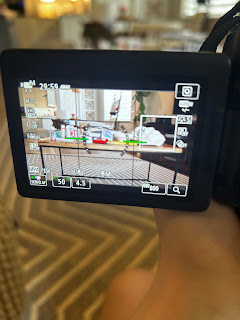
    The camera we used was rented out from a program called Beacon which provides free usage of professional film equipment, by Nyx because of being in TV Production for 3 years. I'm not sure the specific model but we used a Canon camera and a tripod mainly, since we forgot to bring the ring lights Nyx owns. I loved the way the camera's quality performed, including its features of different focuses. During filming we played with different focuses in one shot, overshooting in case it didn't come out to our intended vision. But I believe the shots' variations between specific areas of focus and unfocused shots, especially within close ups, definitely improved our opening much more than I had imagined. The tripod additionally allowed for precision and improved our still shots, which make up the majority of our opening, as we played with handheld shots and camera movements as the story progressed later.


    Personally, I believe the first about 40 seconds filmed - about 5/6 shots - were phenomenal. It included the long shot of walking into the room, a medium of walking past art mediums/utilities, close ups of pouring paint and turning on lights, setting up a record, and beginning to paint - which was an overhead shot that I absolutely adored. In each of these, we had to play with lighting to make up for the area's weaknesses. For example, since we didn't bring a ring light, we used a nearby lamp (established through her turning it on) to shine light upon the desk since it was considerably dark due to the natural light coming in opposite the desk (casting a shadow on the desk). Additionally, the background of the turning-on-light shot was again considerably dark since we wanted to utilize mainly natural light. It didn't bode well with the opening's tones and characterization so we had to use the house lights (that were naturally yellow/orange which helped keep the facade of natural light) to make up for it. Furthermore, despite the limited space for our movement and freedom in filming, we were able to open the window and shoot from the outside in, and that idea entirely elated me since it was a clever addition and displayed a more professional use of space and shots. 

    This beginning sequence is entirely for 2 things: establishing characterization and introducing credits. The slow pace of the character, still shots, and music indefinitely sets up heart-warming, serene tones which contribute to characterization and ease the introduction of credits, additionally highlighted by natural light and warm tones of the surrounding objects, including light brown wood tables and desks, a hanging threaded hearts, and numerous plants. 

    The frustrations mainly came up later in filming, where we begun to film our serene painting freedom section. This sequence mainly used close ups and extreme close ups (ecu) of the character's eyes, paint brush, the painting itself, and also a long shot from behind the character, which in post-production will be changed into a slow zoom out, another shot I believed was phenomenal. However, this vision of a slow zoom out is perfect for a sense of finality, and organized/settled peace within the character, a shot I intended to use as the final shot before the increasing anxiety sequence. But, this was argued against as a slow zoom in to portray the transition from serenity into anxiety. Personally, I believe the shot as a slow zoom out would portray the finality much stronger than a zoom in acting as a transition, since the transition could be portrayed through other mediums/shots, for example through acting and distorted shots (editing, angle, indiscernible shots/images - out of focus ecu's). The matter was settled undetermined, to simply see how it plays out in post-production. Also, the order in which some/most shots are presented is currently undetermined.

    Since the serenity section used many close ups and ecu's, the anxiety section must vary in numerous ways to definitively portray a distinct contrast and anxiety. However, in the most logical sense, close ups and ecu's (as aforementioned through editing, angle, indiscernible/out of focus ecu's) would easily portray such. And so, repeated shots of similar if not the same angles and composition were used which quite frustrated me since there also wasn't many variations to work with. One aspect that can solve such an issue would be to incorporate more out of focus shots, quick cuts and distorted angles, all of which we used/will use. However, this feeling of frustration due to the limitations is still present, which again, I assume can only recede during post-production.


    Furthering my frustration, the ways in which we portrayed a frustrated, anxious character was... questionable. It was previously undetermined in our methods of portrayal, not by editing, composition/angle, and focus, but by the content being shown. Instead of staying on the same painting (which we also included different mediums like color pencils), the character switched pages and scribbled random, indiscernible images of whatever came to mind. Frankly, the images looked stupid, the ways in which it was portrayed weren't. For example, (another solution to the same-shots) we now used extravagant camera movement, handheld techniques, and focus to portray such. But honestly, I don't believe switching pages was the right way, content-wise. It did provide some phenomenal shots, such as following her hand as she frantically switches mediums (brush/pencil), and switched pages, shots I loved. But I don't think it makes sense, and I believe it looks abruptly unprofessional, and extremely contrasts our previous performance level. However, I will not delete the footage, since in post-production I'd like to create different variations of the film opening, one will use the shots aforementioned, and another will void usage of drawn/painted images I simply don't like, instead using the same painting and mainly portray anxiety through shot techniques, camera and character movement (and acting), and editing through quick cuts and vastly different sound (as discussed in previous posts). 

    One more production limitation was time. Since the opening mainly utilizes natural light, there is a small window in which we can film. Again, since the Beacon equipment is rented out by Nyx since I am not apart of the program and am ineligible, Nyx must be present for its usage. However, Nyx is busy with many field trips and TV Production jargon stuff - practically the majority of the month, limiting our filming days to 2. So, the remaining sequences; obstructive piece/title transition, drinking water story continuation, and reshooting of the anxiety sequence, will have to be conducted on the one remaining filming day, starting afterschool, in other words, from 4-7, 3 hours. Extremely, extremely constrained, and extremely unfortunate. We would film over spring break but I don't believe Beacon equipment is allowed to be rented out during it. Luckily, from 4-7 is daylight hours, and we only need those hours just for the reshooting anxiety sequence, which is not the majority of filming, and we can make up for the facade of natural light through other lighting mediums... hopefully. Therefore, from 7 and on is fair game - again, hopefully. I will ask to see if it can be rented out over spring break so that we have more filming time freedom. 

Friday, March 8, 2024

Correlations Between Dopamine and Hallucinations

    As highlighted by the article, large amounts of dopamine factors into the likeliness of emerging hallucinations and delusions. As a result, taking drugs that would repress dopamine production, formally labelled antipsychotic medications, would alleviate the prevalence of hallucinations. In our original storyboard, we had decided to transition after the title card/obstructive piece into the character drinking water to calm her nerves and displaying a doctor's appointment held up nearby. To further solidify the fact the previous sequence was a hallucination, we decided to add her taking pills with water and include the doctor being a psychiatrist so that such is thoroughly defined. Additionally, my dog coming into frame can be interpreted similar to a support dog for her. 


    Kumar, S., & Soren, S., & Chaudhury, S. (2009). Hallucinations: Etiology and clinical implications, Industrial Psychology Journal, 18(2), 119-126. 10.4103/0972-6748.62273

Wednesday, March 6, 2024

Color Theory and Costume Design: A Professional Psychologist's (me) Review

    As the wonderful Ms. Stoklosa has taught, color theory would have to play a significant role in the creation of the obstructive piece. Similar to Jill Dowell's painting, we'd like to not paint something specific along the border or within the open space, but to simply have randomized splotches along the border of different colors to represent her creative freedom, with the blank space representative of her restricted mind. Color theory dictates colors are generally representative of certain emotions or concepts, and after reviewing each, we believe it would be best to avoid use of specifically green and yellow, that signify forms of health. Additionally, they aren't as potent colors, and wouldn't fit naturally with the rest of the colors, which would most likely be darker.


    Another significant factor in characterization and tone-setting is costume design. My sister and I reviewed our closets and found that we practically wear only dark colors and definitely did not have clothes to fit our character and opening's tones. However, I found a thin white blouse and lightly faded jeans that she could wear, which looked fitting for the story, despite opposing some logical concern of if people would wear a semi-nice blouse and jeans to paint when paint would most likely get on them. We also didn't have a large selection, or really any other option for her to wear so let's chalk it up to her simply being extremely neat. 


 jokes on you, the project is postponed. I’m working on a novel now.